
About This Issue
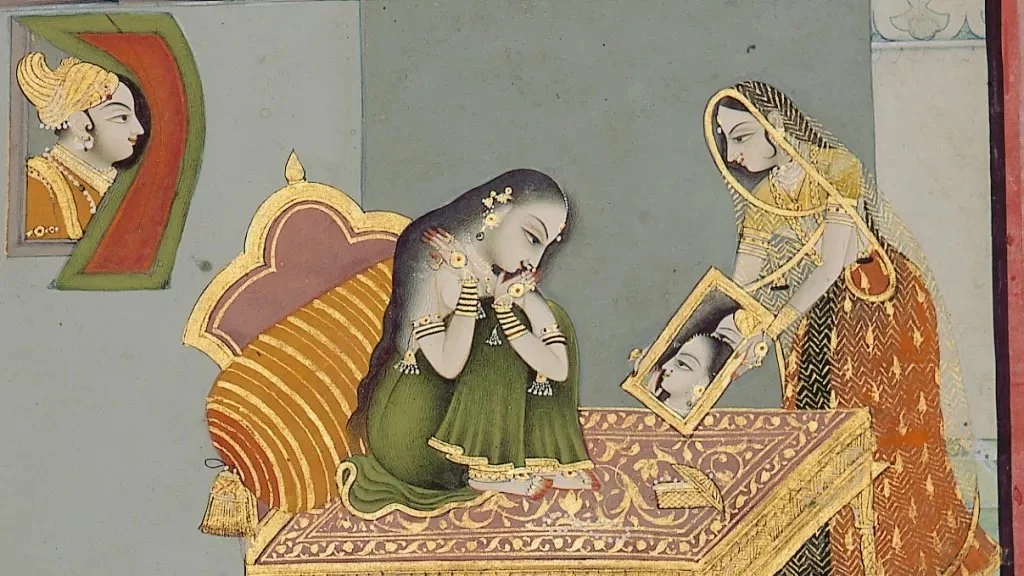
What do you see in this mid-18th century painting from the Bundi School? Do you see a moment of romance — a lover peering through the window, and the woman’s sudden embarrassment at spotting him while getting dressed? Or do you see a moment of intrusion — a male gaze appearing in the mirror, in the lady’s most private quarters, her mind? This issue of Mausam explores the gaze South Asian girls see when they look in the mirror today, the history of how that came to be, and the stories and art that our 8-12 year old girls at The Banyan Tree have created to counter this long history. From colorism to eyebrows to hair, we will let our 8-12 year olds reveal to you what is going on in their beautiful minds, and how they are making choices for themselves.
In Snow White, the stepmother asks, "Mirror, mirror on the wall, who is the fairest of them all?" For South Asian girls, "fairest" has long meant "lightest"—encoding beauty with whiteness. When I was 4-years-old, I came home from school and told my mom I wanted to be white, blonde, and have thin hair. In retrospect, as an adult, it seems like such a silly thing. I love my melanated skin and thick black hair. But because I work closely with South Asian youth, I also know that not much has changed since my childhood in the 1990s. As the stories in the magazine will illustrate, giving South Asian girls the tools and space to love brown is in fact a difficult and radical educational project.
This issue will also talk about the eyebrow, specifically, the unibrow. I recently interviewed a woman who was growing up in San Francisco in the 1950s. She confessed that one of her most vivid memories of childhood was stealing her father’s razor at the age of 11, and shaving her unibrow. She wanted some relief from the profound shame of her unruly brows. But her family’s religious practices explicitly forbade the removal of body hair. She got in big trouble. What stunned me about her story, was that I did the exact same thing in the 1990s, and I’ve met girls who continue to do the same thing well into the 2020s. What is this intergenerational inheritance? Why are these occurrences so pervasive?
The pervasiveness of South Asian girls’ body modification practices should not be trivialized. The effect and the numbers are striking. A literature review in The Columbia Journal of Asia found that South Asian American women face higher rates of appearance-based commentary and body dissatisfaction than their white peers (Khasru, 2022). Studies document pressures to achieve competing and often contradictory ideals—light skin, dark hair, minimal body hair, thinness and "healthy" curves simultaneously—with much of this commentary coming from within families (Goel et al., 2021).
What are the long-term impacts of this? While we don’t know exactly, we know there is an impact on mental health. A UK community cohort study found that South Asian participants were nearly twice as likely to report depressive symptoms as white Europeans, with South Asians reporting 15.5% versus Europeans’ 9.7% (Tillin et al., 2016, Psychological Medicine). U.S.-born Asian American women have significantly higher rates of suicidal ideation, suicide plans, and suicide attempts than U.S.-born Asian American men, immigrant men, or immigrant women (Duldulao et al., 2009, Asian American Journal of Psychology). Among Asian American women aged 15–24, suicide is the leading cause of death—the only racial group in this age bracket for whom this is true (CDC, via Hahm et al., 2020, Psychiatric Services).
But here's what statistics can’t capture: the hours and lives lost in anguish. The mental real estate consumed by self-surveillance. What might our daughters be imagining, creating, dreaming—or simply resting with—if the mirror weren't always asking them to measure themselves against a critical gaze? Would they feel more comfortable leaning on the hereditary beauty care rituals that have been carefully passed down from mother to daughter over generations: the coconut oil for the scalp, lemon for dandruff, amla and henna for protection and color? Because when we lose this knowledge, we also lose a thread of connection to the love of those who came before us, and their prayers for us to live happy, healthy lives.
This issue of Mausam traces the history of beauty ideals across South and Central Asia, and shares stories of resistance old and new. We'll learn that the unibrow was once celebrated in Persian poetry as "abroo kamoon," the bow-like brow. We'll discover that the word" shampoo" comes from the Hindi "chāmpo," meaning head massage, and that the oiling practices our grandmothers passed down represent thousands of years of accumulated knowledge. We'll meet young artists from our programs who are reimagining how they can see themselves as they find freedom in their minds and hearts.
Can we change what girls see when they look in the mirror? Yes. After participating in The Banyan Tree's 5 day summer camp, the percentage of children reporting they were 'happy with my reflection in the mirror' rose from 23% to 56%, and those who said they 'feel good about myself' jumped from 14% to 78% (n=13 participants).
The mirror itself isn't the problem. The problem is what we have learned to look for.
Welcome to Mausam's exploration of beauty, belonging, and the long work of learning to see ourselves anew.
Thank you for joining us on this journey.
By Tara Kola
Co-Founder & Executive Director, The Banyan Tree